


Will AI Replace Pandits and Astrologers Honest Answer 2026
31 Aug 2026 • 1 min read

SanatanAI
Author

 159
159 159
159
Quick answer
Pandits: no. Astrologers: partly, and it has already been happening for thirty years. A pandit's work is ritual performance — fire, samagri, sankalp, presence — and software cannot do any of it. For astrologers, the calculation half was automated by desktop Jyotish software in the 1990s and the profession grew anyway. The clearest evidence is recent: India's largest astrology platform expanded its AI features in 2025 and its revenue rose roughly 85% in FY25, while still working with more than 15,000 astrologers. What AI erases is generic practice, not skilled practice.
This question gets asked in two very different tones. Sometimes it comes from a young person deciding whether to study Jyotish. Sometimes from a pandit who has watched his sons choose other work. And sometimes from a devotee who feels vaguely uneasy about typing a question that his grandfather would have taken to a person.
We build an AI astrologer and we also run a verified pandit network, so we are answering a question about our own business — which is a reason to check what we say rather than take it. So the argument below leans on evidence rather than reassurance.
First, separate the two jobs
Almost every article on this topic treats "pandit" and "astrologer" as one profession. In practice they are different work with very different exposure to automation, and merging them produces a muddled answer.
The pattern is consistent: information is automatable, performance and judgement are not. A pandit's core work sits almost entirely in the second category.
Why pandits are not being replaced
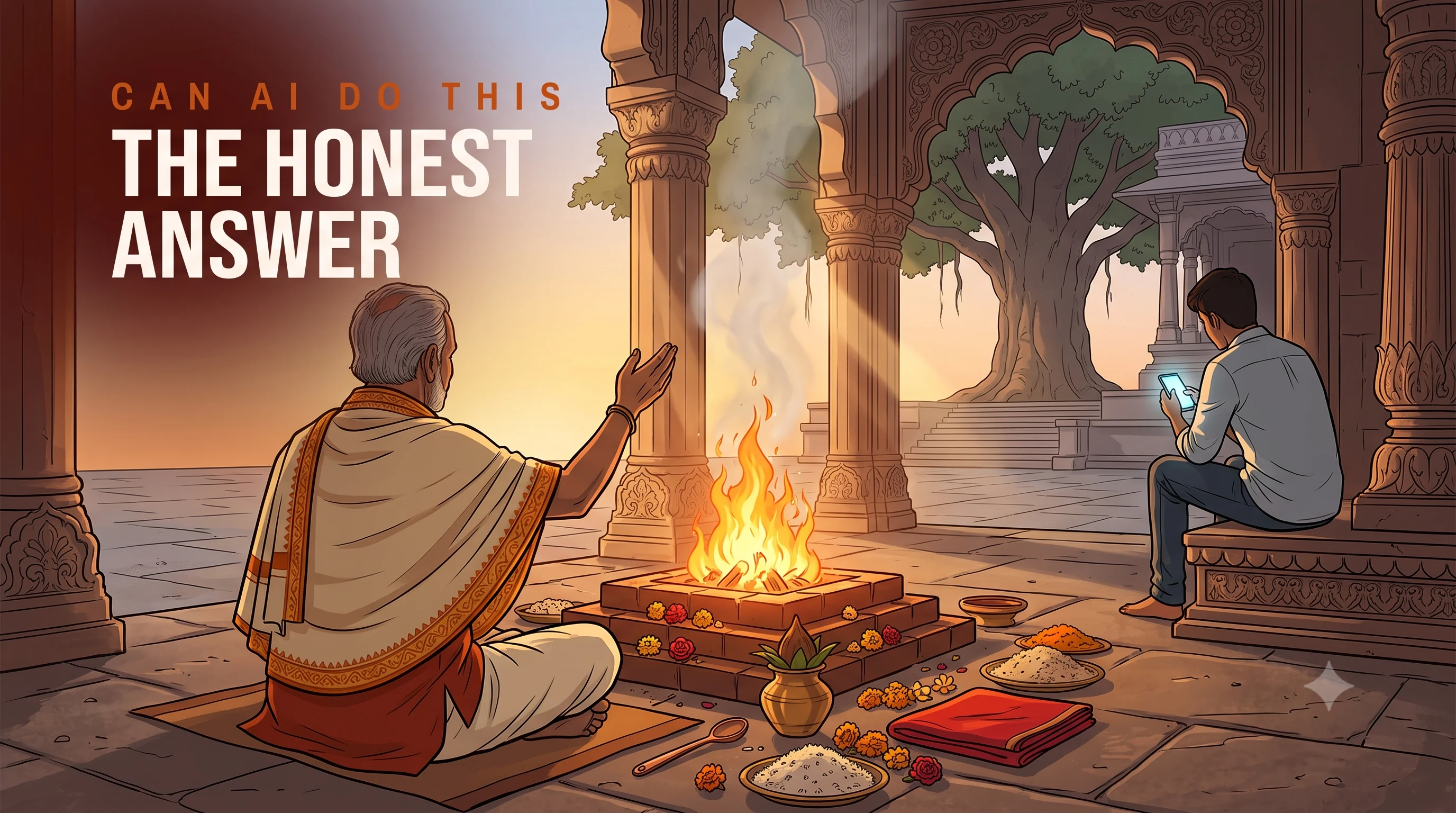
Software can tell you which puja suits your situation, list the samagri, and find you an auspicious muhurat. It cannot light the fire.
A ritual is not information transfer. It requires a qualified person physically present, performing prescribed actions in a prescribed order, speaking the sankalp in the name of a specific family and gotra. Sit through a shraddh or a griha pravesh and it becomes obvious that what the family is receiving is not data. They are receiving a person who has come to their home, who knows what to do, and who carries the responsibility of doing it correctly.
There is a second thing that gets missed. A pandit is often the only person a family will speak to honestly at a difficult moment — a death, an illness, a marriage in trouble. That role has never been about the ritual alone, and it is the last thing a chat interface will take over.
What actually changes for pandits
Not demand. Discovery. The way families find a pandit has moved online, and that is a genuine shift — a pandit whose work depends entirely on the immediate neighbourhood is more exposed to that change than to AI. Booking platforms, verified profiles and city-level search now decide who gets called.
That is a real risk, and it has nothing to do with artificial intelligence.
For astrologers, the honest answer is more complicated
Here the automation is real, but it did not begin in 2023.
Desktop Jyotish software that computes charts, divisional charts, ashtakavarga and dasha periods has been in professional use since the 1990s. Before that, printed ephemeris tables automated the same arithmetic. Astrologers have been outsourcing calculation for roughly thirty years, and the response was not collapse — practitioners adopted the tools, spent the saved hours on consultation, and the profession grew.
AI extends that same line. It automates more of the preparation and, increasingly, the first layer of interpretation. What it has not touched is the part that was always the actual service.
The evidence nobody in this debate cites
Most articles on this question are speculation. There is real data available, and it points in a direction that surprises people.
The leader added AI and grew
Astrotalk expanded AI-assisted features in 2025. Its FY25 revenue rose roughly 85% to about ₹1,214 crore, up from around ₹651 crore in FY24.
While employing more humans
The same platform reports working with over 15,000 active astrologers and holding roughly 80% of India's online astrology market.
The category is expanding fast
India's astrology app market was valued in the hundreds of millions of dollars and is projected by multiple analysts to multiply several times over by the early 2030s.
And the sector is crowded
Tracxn counted more than 900 religious-technology startups in India, with sector funding rising from around $88,000 in 2015 to roughly $50 million in 2024.
Read those together. The most AI-forward platform in the market is also the largest employer of human astrologers in the market, and both numbers rose at the same time. If AI substituted for astrologers, that is not the pattern you would expect to see.
The mechanism is straightforward once you look at who is arriving. A free or near-free AI reading brings in people who would never have paid ₹700 to consult a stranger — the curious, the sceptical, the young, families abroad with no pandit nearby. Some of them find the reading useful, and a share of those go on to want a real conversation. The technology widens the top of the funnel rather than removing the bottom of it.
Figures above are drawn from published market reporting on the Indian astrology app sector and from Astrotalk's reported financials; company figures are as reported in the press and were current in mid-2026.
The hardest test: can AI chant Sanskrit correctly?
If you want to find the edge of what AI can do in this field, do not look at chart calculation. Look at pronunciation.
Sanskrit is unusually unforgiving. Its phonetics carry distinctions that most modern Indic languages have softened or lost: the retroflex series, three separate sibilants, aspirated and unaspirated pairs, visarga sandhi, the homorganic anusvāra, vowel length, and in Vedic recitation the svara accents that change a syllable's pitch. Sandhi rules reshape words where they meet. Metre governs the rhythm of a verse. Get any of it wrong and the recitation is not merely accented — for ritual purposes it is incorrect.
This is precisely where general-purpose text-to-speech breaks. Models trained on modern Indic languages flatten the distinctions that matter most, because those distinctions barely exist in the training data. One voice-AI provider building in this space says so directly, describing Sanskrit as a pilot-quality tier and disclosing that its output is not yet on par with modern Indic languages. That is an honest position, and a rare one.
The serious attempt
At IISc, a Sanskrit speech stack led by Dr. Prathosh A.P. includes Vāgdhenu, a metre-aware śloka-to-chant TTS that detects a verse's vṛtta and renders it as pārāyaṇa recitation, keeping the retroflex series, sibilants, aspiration, visarga sandhi and anusvāra distinct.
Trained properly
It was built on a purpose-recorded single-speaker Sanskrit chant corpus and reports an expert listener score around 4.6 out of 5 — and has already generated chant corpora at scale, including the full Śrīmad Bhāgavatam.
Recognition too
The same group's Su-śrotā is a speech recogniser tuned for śāstric and recitational Sanskrit, where general-purpose models fail, alongside a learning app for daily practice.
The commodity end
Meanwhile a growing number of free tools advertise Sanskrit TTS for devotional video content. Quality varies enormously, and most are Devanagari readers rather than trained chant models.
So the honest answer is that machine chanting is a real research field, it is advancing quickly, and the best of it is good. Which raises the question this whole article turns on.
Correct chanting is still not a ritual
Suppose the pronunciation problem is fully solved tomorrow — perfect svara, perfect sandhi, indistinguishable from a trained reciter. A pandit is still not replaced.
Recitation is one component of a ritual, not the ritual. A puja requires a qualified person physically present, performing prescribed actions in sequence, handling the samagri and the fire, and taking the sankalp in the name of a specific family and gotra — an act of representation, made by someone who accepts responsibility for making it. A recording of correct Sanskrit is a recording. It is not a sankalp.
This is the clearest illustration of the line running through this entire article. AI is closing in on the information layer of Sanskrit, including its hardest parts. It is nowhere near the performative layer, and that is not a gap that scale or better models close.
Where Sanatan AI stands on this
Being straight about it: Sanatan AI today supports typed and voice input across twelve or more Indian languages, so you can ask your question in Hindi, Marathi, Tamil, Telugu or English and get the reading in the same language. That part is live.
Accurate Sanskrit chant output — mantra and stotra recitation with correct svara and sandhi — is something we are working towards, not something we are claiming today. We would rather tell you that than ship a Devanagari reader with the pronunciation flattened and let you find out. When it is genuinely accurate, we will say so, and you will be able to judge it by listening.
And even then, we will point you to a pandit for the puja itself. That is not modesty. It is what the ritual actually requires.
Who is genuinely at risk
Not every practitioner is equally safe, and it would be dishonest to pretend otherwise.
At risk: the generic reading
If your output is a sun-sign paragraph or a standard interpretation printed from software, that is now free and instant. It was already commoditised; AI finished the job.
At risk: charging for calculation
Charging for a chart, a matching score or a dasha table is charging for arithmetic. That business has been eroding for three decades.
At risk: volume over depth
Practitioners competing on speed and price rather than knowledge are competing directly with something that has no marginal cost.
Safe: specific judgement
Reading a chart against a person's actual circumstances, resolving contradictory indications, being accountable for the advice.
Safe: ritual performance
Every puja, havan and sanskar. There is no software path to this and there is not going to be one.
Safe: the relationship
Families keep the same pandit for decades and across generations. That is not a transaction anyone is disrupting.
What we would tell a pandit or astrologer today
Three things, plainly:
- Stop charging for the arithmetic. It is free now, and defending it makes you look like you are defending a fee rather than a skill. Give the chart away and charge for the reading.
- Use the tools. The hours previously spent preparing a chart before a consultation can go into the consultation instead. Practitioners who adopted desktop Jyotish software in the 1990s did not lose their practices; they saw more people.
- Be findable. The real disruption to a traditional practice is not AI, it is that families now search online for a pandit. If you are not there, you are invisible regardless of how good you are. We list verified pandits at PujaPurohit.
How we actually run it
PujaPurohit operates Sanatan AI and a verified pandit network side by side, and routes between them on purpose rather than by accident.
Sanatan AI handles what should be free: sidereal chart generation with divisional charts from D1 to D60, dasha and transit timelines, 36-point Guna Milan with Mangal Dosha, Nadi and Bhakoot checks, and the first layer of interpretation across Vedic, Lal Kitab and KP — in twelve or more Indian languages, with the reasoning shown so you can check it. Free to start at three chats a day, no card.
When the question turns into a decision, or into a ritual that has to be performed, it goes to a person. That is not a limitation we are apologising for. It is the design.
See where the line falls for yourself
Generate your kundli, check the planetary positions and dasha periods, and ask one real question. Free to begin, no card required.
Try Sanatan AI freeThe longer view
Jyotish has absorbed technology before. The shift from oral transmission to written manuscripts, from manuscripts to printed panchangs, from hand calculation to ephemeris tables, from tables to desktop software. Each arrived with the same anxiety and each ended the same way: the calculation got easier, the knowledge stayed with the people who had it.
What changes is where a practitioner's value sits. It moved off arithmetic decades ago. AI is simply making that visible to everyone at once.
If you want the detail on what the calculation layer involves and why accuracy claims do not survive scrutiny, we have written that in is AI astrology accurate, and the task-by-task comparison in AI astrology vs human astrologer.
Frequently asked questions
Will AI replace pandits?
No, and the reason is structural rather than sentimental. A pandit's work is the performance of ritual — being physically present, lighting the fire, handling the samagri, speaking the sankalp aloud on behalf of a family, and holding the room while it happens. Software can describe a puja vidhi and list the samagri, but it cannot perform a Rudrabhishek, conduct a griha pravesh, or sit with a family during shraddh. That is not a small caveat. It is the job.
Will AI replace astrologers?
Not wholesale, but the profession is being reshaped. The calculation half of astrology has already been automated for around three decades, and the number of working astrologers grew during that period rather than shrinking. What AI compresses is the value of routine chart generation and generic readings. What it does not touch is skilled consultation: weighing contradictory indications, counselling a family through a difficult result, and taking responsibility for advice.
What does the market data actually show about AI and astrologers?
India's largest astrology platform, Astrotalk, expanded its AI-assisted features in 2025 and its revenue grew roughly 85 percent in FY25 to about ₹1,214 crore, while the platform continued to work with over 15,000 active astrologers. Adding AI did not reduce demand for human practitioners on the same platform. The wider Indian astrology app market is projected to grow rapidly through the rest of the decade. The evidence so far points to expansion of the category rather than substitution of the people in it.
Has astrology software existed before AI?
Yes, for roughly thirty years. Desktop Jyotish software that computes charts, divisional charts and dasha periods has been in professional use since the 1990s, and printed ephemeris tables automated the same arithmetic long before that. Practising astrologers adopted these tools rather than being displaced by them, and the profession grew. AI continues that trajectory: it automates more of the preparation, not the counsel.
Which astrologers are actually at risk from AI?
The ones whose service is generic. If a practitioner's output is a sun-sign style reading, a chart printout with standard interpretations, or answers that could apply to almost anyone, that work is now available instantly and at near-zero cost. The practitioners who are not at risk are those whose value is judgement, specificity and relationship — reading a chart against a person's actual situation and being accountable for what they advise.
Can AI chant Sanskrit mantras with correct pronunciation?
Partly, and it is improving quickly. Sanskrit is hard for speech models because it preserves distinctions that modern Indic languages have softened — the retroflex series, three sibilants, aspiration, visarga sandhi, homorganic anusvāra, vowel length, and in Vedic recitation the svara accents. General-purpose Indic text-to-speech flattens these. Purpose-built research systems do far better: a Sanskrit speech stack at IISc includes a metre-aware chant TTS trained on a dedicated recitation corpus that keeps those distinctions intact. Correct chanting, however, is not the same as a performed ritual.
Does Sanatan AI support voice and Sanskrit chanting?
Sanatan AI supports typed and voice input across twelve or more Indian languages, so you can ask in Hindi, Marathi, Tamil, Telugu or English and receive the reading in the same language. Accurate Sanskrit chant output with correct svara and sandhi is something we are working towards rather than claiming today, because a Devanagari reader with flattened pronunciation is worse than none. Even once it is accurate, the puja itself is performed by a pandit.
Can AI perform a puja or a ritual?
No. A puja requires physical performance — the fire, the samagri, the mantras spoken aloud, the sankalp taken in the name of a specific family and gotra, and a qualified person present to conduct it correctly. AI can help you understand the vidhi, prepare the samagri list, find an auspicious muhurat and choose the right ritual for your situation. The ritual itself is performed by a pandit.
Should someone still become an astrologer or pandit in 2026?
Yes, but with clear eyes about what the work now is. The parts that were once time-consuming and chargeable — calculating charts, drawing divisional charts, computing dasha tables — are now free and instant. The value has moved to interpretation, counsel and ritual performance. A practitioner who invests in depth of knowledge and in the relationship with the person in front of them has a stronger position now than one who competed on producing charts.
How should pandits and astrologers use AI rather than fear it?
Use it for the preparation that used to consume the hours before a consultation: chart generation, divisional charts, dasha timelines, matching scores and muhurat options. That leaves more of the appointment for the conversation, which is what the person actually came for. Practitioners who adopt the tools generally handle more consultations at a higher quality, in the same way earlier generations adopted desktop Jyotish software.
Does PujaPurohit replace pandits with AI?
No. PujaPurohit runs both an AI astrologer, Sanatan AI, and a verified pandit network, and routes deliberately between them. Sanatan AI handles chart generation, dasha analysis, matching scores and the first layer of interpretation. When a question becomes a decision or a ritual, it goes to a verified pandit. The AI brings people into the system who would never have consulted anyone at all, and a share of them go on to book a real pandit.
Is AI astrology a threat to traditional Jyotish knowledge?
It depends entirely on how it is built. A system that generates pleasant-sounding predictions with no chart underneath erodes the tradition. A system that computes the chart properly, applies documented rules from the classical texts and shows its reasoning makes that tradition more accessible than it has ever been, particularly to younger people and to families abroad who have no pandit nearby. The technology is neutral; the implementation is not.
Related reading
- Is AI astrology accurate? A free AI astrologer guide
- AI astrology vs human astrologer: which should you trust?
Free to start, no card. Try Sanatan AI
Vivah Muhurat 2026 & 2027: North & South Indian Wedding Dates After September
Complete Vivah Muhurat 2026 and 2027 list — North Indian Panchang and South Indian (Telugu, Tamil, Kannada) Panchangam wedding dates from November 2026 onward. Kharmas, Dhanurmasam and Chaturmas explained. Book a verified Pandit for Vivah at home in Delhi NCR, Mumbai, Pune, Bangalore, Hyderabad & Ahmedabad.
Shravan 2026 Complete Guide: Dates, Somvar Vrat, Rudrabhishek, Nag Panchami, Varalakshmi Vratam, Bonalu & Pandit Booking
Shravan 2026 complete guide — North India: July 30–Aug 28 · South/West: Aug 13–Sep 11. All Sawan Somvar dates, Rudrabhishek vidhi & cost, Nag Panchami, Varalakshmi Vratam (Aug 21), Mangala Gauri Vrat, Hariyali Teej, Bonalu festival, Aadi Month Tamil Nadu. Book a Pandit for any Sawan puja.
आखिर किसके ध्यान में मग्न रहते हैं भगवान शिव ?
आपने देखा होगा कि भगवान महादेव अक्सर समाधी में ही लीन रहते हैं और ऐसा माना जाता है कि उस समय वो अपने आराध्य देव का ध्यान करते हैं जिसका वर्णन पद्मपुराण के उत्तरखण्ड में किया गया है.
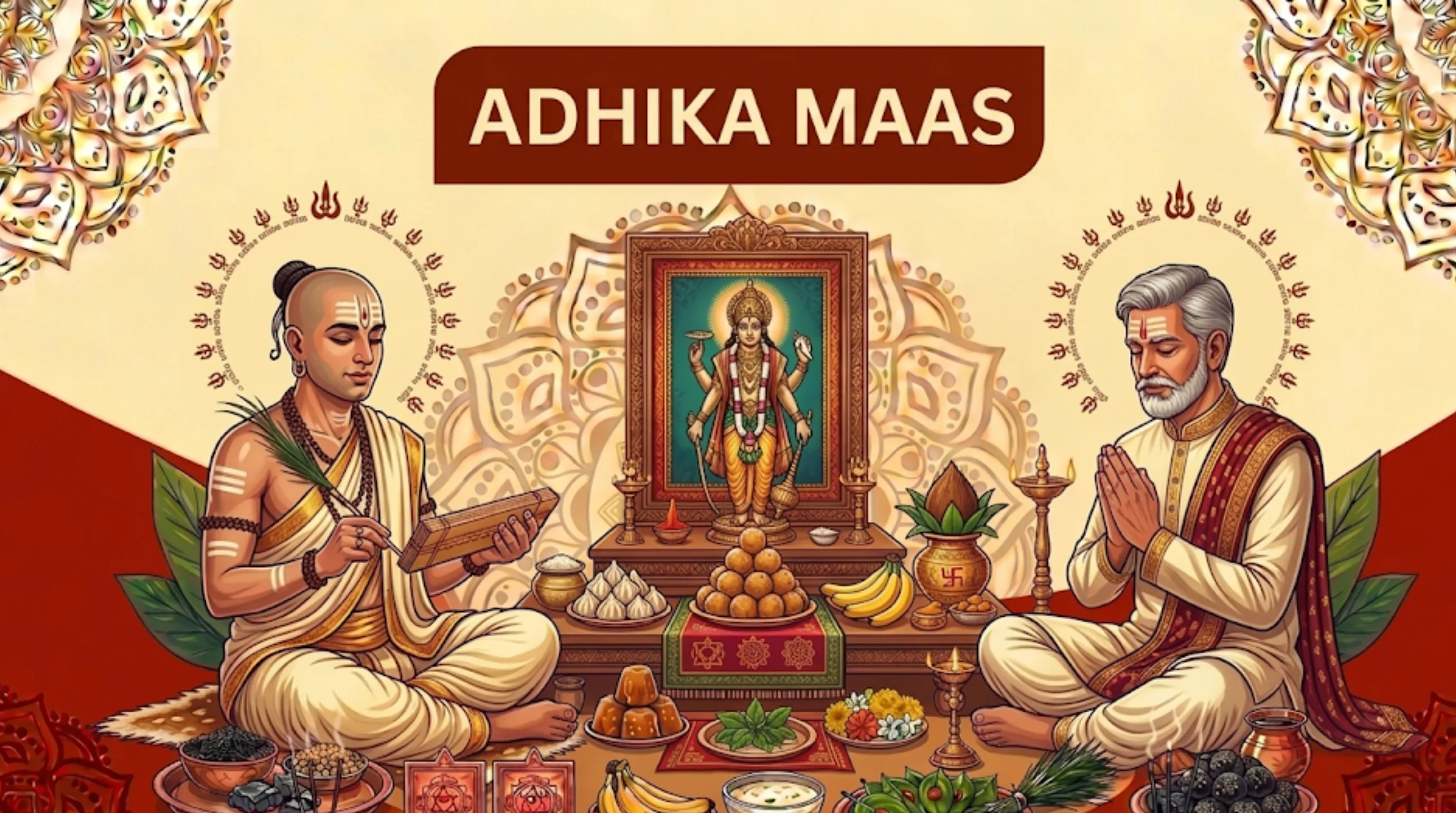
Adhika Maas 2026 Complete Puja Guide What's Banned What's Auspicious & Day-Wise Calendar
Complete guide to Adhika Maas / Purushottam Maas 2026. Dates, significance, banned events, auspicious pujas, day-wise calendar, and how to book a Pandit for Satyanarayan Puja.
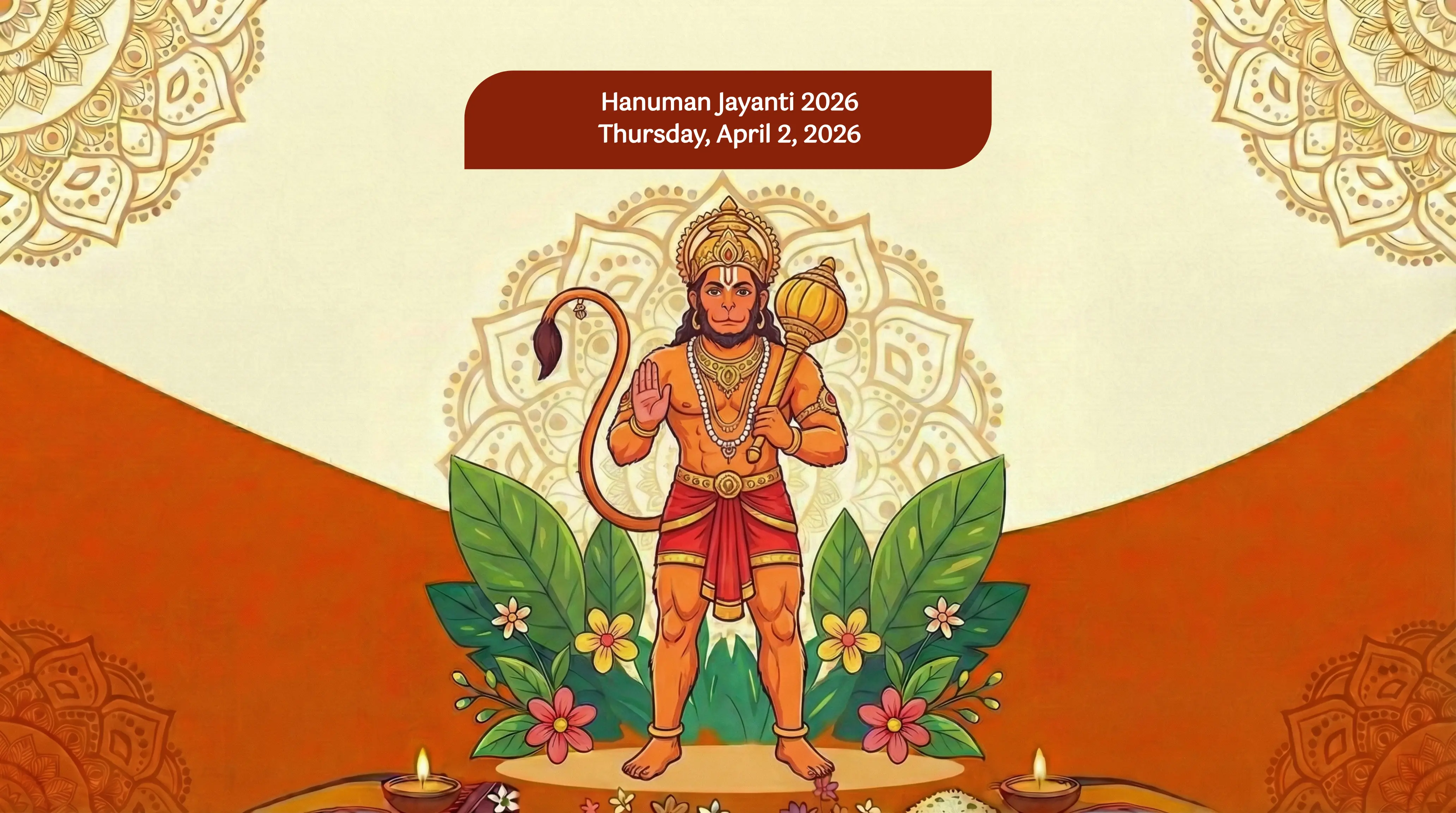
Hanuman Jayanti 2026: Date, Muhurat & Celebrating the Embodiment of Devotion
Discover everything about Hanuman Jayanti 2026, including the auspicious date (April 2nd), muhurat timings, its profound significance, and how to celebrate the birth of Lord Hanuman.
Your spiritual need,
just a tap away.
Your spiritual need,
just a tap away.